Sheet Music
Kleis can generate publication-quality sheet music using the same pipeline as academic papers. A musical score is defined as structured data, compiled to LilyPond source, and rendered to PDF.
Score -> compile_score -> .ly -> lilypond -> .pdf
This mirrors the paper pipeline:
ArxivPaper -> compile_arxiv_paper -> .typ -> typst compile -> .pdf
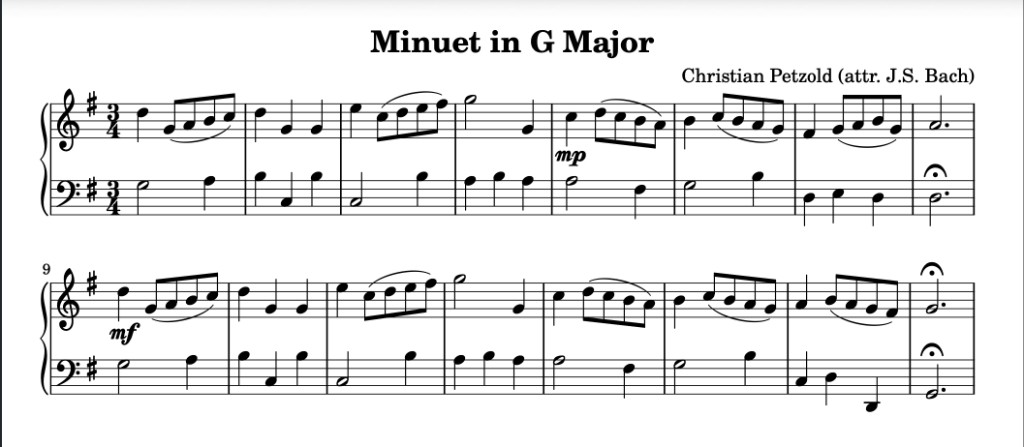
Petzold’s Minuet in G Major rendered from examples/music/minuet_in_g.kleis. Two staves with brace, G major key signature, slurs, dynamics (mp, mf), and fermata — all generated from Kleis data types.
Quick Start
Prerequisites
- Kleis compiled and in PATH
- LilyPond for engraving:
brew install lilypond
Your First Score (5 minutes)
Create a file my_score.kleis:
import "stdlib/templates/sheet_music.kleis"

define my_score = solo_score(
    "My First Score",
    "Composer Name",
    Treble,
    KeySig(C, "major"),
    TimeSig(4, 4),
    Cons(Measure(Cons(n(C, Quarter), Cons(n(D, Quarter),
         Cons(n(E, Quarter), Cons(n(F, Quarter), Nil))))),
    Cons(Measure(Cons(n(G, Half), Cons(n(C, Half), Nil))),
    Nil))
)

example "compile" {
    let ly = compile_score(my_score) in
    out(typst_raw(ly))
}
Generate PDF:
kleis test --raw-output --example compile my_score.kleis > my_score.ly
lilypond my_score.ly
open my_score.pdf
Data Types
The template defines types for two layers of musical notation:
Layer 1: Syntax — Symbolic Tokens
| Type | Constructors | Description |
|---|---|---|
NoteName | C, D, E, F, G, A, B | Note letter names |
Accidental | Natural, Sharp, Flat | Accidentals |
Pitch | P(NoteName, Accidental, ℤ) | Full pitch (octave 4 = middle C) |
Duration | Whole, Half, Quarter, Eighth, Sixteenth, Dotted(Duration), Triplet(Duration) | Note durations |
Clef | Treble, Bass, Alto, Tenor | Staff clefs |
KeySig | KeySig(NoteName, String), KeySigAcc(NoteName, Accidental, String) | Key signature (root + “major”/“minor”) |
TimeSig | TimeSig(ℤ, ℤ) | Time signature (beats, beat unit) |
Layer 1: Events and Annotations
| Type | Constructors | Description |
|---|---|---|
Event | Note(Pitch, Duration), Rest(Duration), Chord(List, Duration), Marked(Event, List), Tuplet(ℤ, ℤ, List), Tempo(String), Spacer(Duration) | Things that happen in time |
Articulation | Staccato, Accent, Tenuto, Fermata, Marcato | Articulation marks |
Annotation | Tie, SlurStart, SlurEnd, Artic(Articulation), Dyn(Dynamic) | Attachments to events |
Dynamic | PPP, PP, Piano, MP, MF, Forte, FF, FFF | Volume markings |
Layer 2: Structure
| Type | Constructors | Description |
|---|---|---|
Measure | Measure(List) | List of events |
VoiceLine | VoiceLine(List) | List of measures for one voice |
StaffContent | Staff(Clef, KeySig, TimeSig, List), VoiceStaff(Clef, KeySig, TimeSig, List) | One staff (single-voice or multi-voice) |
ScoreMeta | ScoreMeta(String, String, String) | Title, composer, subtitle |
Score | Score(ScoreMeta, List) | Metadata + list of staves |
Convenience Constructors
The template provides shortcuts for common operations:
// Notes
n(C, Quarter)                  // C4 quarter note
no(G, 5, Eighth)               // G5 eighth note
ns(F, 4, Half)                 // F#4 half note
nb(B, 3, Quarter)              // Bb3 quarter note

// Rests
r(Quarter)                     // quarter rest

// Measures
m(Cons(n(C, Quarter), ...))    // measure from event list

// Annotations
slur_start(n(C, Quarter))      // c'4(
slur_end(n(E, Quarter))        // e'4)
tied(n(D, Half))               // d'2~
staccato(n(G, Eighth))         // g'8-.
accent(n(C, Quarter))          // c'4->
fermata(n(G, Dotted(Half)))    // g'2.\fermata
dyn(n(C, Quarter), Forte)      // c'4\f

// Tuplets and tempo
triplet(e1, e2, e3)               // 3 events in the time of 2
tempo_mark("Adagio sostenuto")    // \tempo "Adagio sostenuto"
sp(Whole)                          // invisible rest (for multi-voice)

// Key signatures with accidentals
KeySigAcc(C, Sharp, "minor")      // \key cis \minor

// Score constructors
solo_score(title, composer, clef, key, time, measures)
piano_score(title, composer, key, time, treble_measures, bass_measures)
voice_piano_score(title, composer, key, time, treble_voices, bass_measures)
Examples
Solo Instrument: Ode to Joy
A 16-bar excerpt of Beethoven’s theme for single voice:
import "stdlib/templates/sheet_music.kleis"

define m1 = m(Cons(n(E, Quarter), Cons(n(E, Quarter),
         Cons(n(F, Quarter), Cons(n(G, Quarter), Nil)))))
define m2 = m(Cons(n(G, Quarter), Cons(n(F, Quarter),
         Cons(n(E, Quarter), Cons(n(D, Quarter), Nil)))))
// ... more measures ...

define ode = solo_score("Ode to Joy", "Ludwig van Beethoven",
    Treble, KeySig(C, "major"), TimeSig(4, 4), ode_measures)

example "compile" {
    out(typst_raw(compile_score(ode)))
}
See the full example: examples/music/ode_to_joy.kleis
Piano: Minuet in G Major
A two-staff arrangement demonstrating slurs, dynamics, and key signatures:
import "stdlib/templates/sheet_music.kleis"

define fis(oct, dur) = Note(P(F, Sharp, oct), dur)

// Right hand with slurs and dynamics
define rh1 = m(Cons(no(D, 5, Quarter),
           Cons(slur_start(no(G, 4, Eighth)),
           Cons(no(A, 4, Eighth),
           Cons(no(B, 4, Eighth),
           Cons(slur_end(no(C, 5, Eighth)), Nil))))))

// Left hand with walking bass
define lh1 = m(Cons(no(G, 3, Half), Cons(no(A, 3, Quarter), Nil)))

// Assemble as piano score (auto-detects two staves -> PianoStaff)
define minuet = piano_score(
    "Minuet in G Major",
    "Christian Petzold (attr. J.S. Bach)",
    KeySig(G, "major"),
    TimeSig(3, 4),
    treble_measures,
    bass_measures
)

example "compile" {
    out(typst_raw(compile_score(minuet)))
}
The piano_score constructor creates two staves. When compile_score detects
exactly two staves, it wraps them in a LilyPond \new PianoStaff block,
which draws a brace connecting them.
See the full example: examples/music/minuet_in_g.kleis
Multi-Voice Piano: Moonlight Sonata
The opening 14 measures of Beethoven’s Op. 27 No. 2 demonstrate the most advanced features: multi-voice staves, triplet grouping, tempo markings, and accidentaled key signatures.
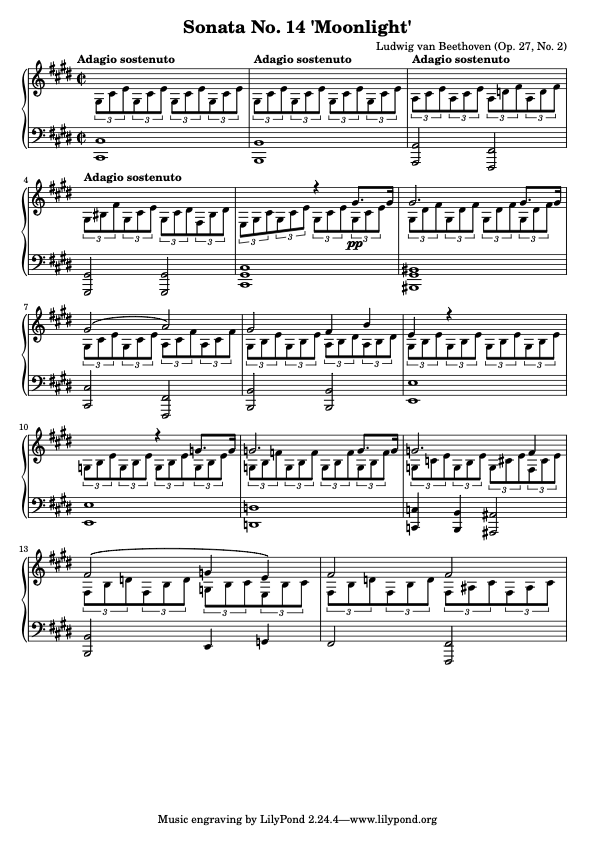
Beethoven’s Moonlight Sonata (measures 1–14). Treble staff with two simultaneous voices: melody (stems up) entering at measure 5, continuous triplet arpeggiation (stems down). Bass staff with sustained octave pedal tones. C# minor, cut time.
The three-layer texture requires a VoiceStaff — a staff containing
multiple VoiceLine objects that play simultaneously:
import "stdlib/templates/sheet_music.kleis"

// Triplet arpeggiation pattern (3 eighths in the time of 2)
define t_csm = triplet(
    Note(P(G, Sharp, 3), Eighth),
    Note(P(C, Sharp, 4), Eighth),
    Note(P(E, Natural, 4), Eighth))

// Each measure has 4 triplet groups
define acc1 = m(Cons(t_csm, Cons(t_csm, Cons(t_csm, Cons(t_csm, Nil)))))

// Melody: spacer rests where voice 1 is silent, then enters pp
define mel1 = m(Cons(tempo_mark("Adagio sostenuto"), Cons(sp(Whole), Nil)))
define mel5 = m(Cons(sp(Half), Cons(Rest(Quarter),
             Cons(dyn(Note(P(G,Sharp,4), Dotted(Eighth)), PP),
             Cons(Note(P(G,Sharp,4), Sixteenth), Nil)))))

// Two voices share the treble staff
define treble_voices = Cons(VoiceLine(melody_measures),
                      Cons(VoiceLine(accomp_measures), Nil))

// Assemble: multi-voice treble + single-voice bass
define moonlight = voice_piano_score(
    "Sonata No. 14 'Moonlight'",
    "Ludwig van Beethoven (Op. 27, No. 2)",
    KeySigAcc(C, Sharp, "minor"),
    TimeSig(2, 2),
    treble_voices,
    bass_measures
)
Key features demonstrated:
VoiceStaffcompiles to<< { \voiceOne ... } \\ { \voiceTwo ... } >>in LilyPond, giving each voice automatic stem directiontriplet(e1, e2, e3)compiles to\tuplet 3/2 { e1 e2 e3 }tempo_mark("...")produces\tempo "..."with zero duration (doesn’t affect measure completeness)sp(dur)produces invisible rests (sin LilyPond) so voice 1 doesn’t print rests where it’s silentKeySigAcc(C, Sharp, "minor")compiles to\key cis \minor
See the full example: examples/music/moonlight_sonata.kleis
Measure Completeness Verification
The template includes duration arithmetic so you can verify that measures add up correctly:
// Duration values (in sixteenths of a whole note)
duration_value(Whole)           // 16
duration_value(Half)            // 8
duration_value(Quarter)         // 4
duration_value(Dotted(Quarter)) // 6

// Check a measure sums to its time signature
let ts = TimeSig(4, 4) in
assert(measure_duration(my_measure) = measure_expected_duration(ts))

// Works for any time signature
let waltz = TimeSig(3, 4) in
assert(measure_expected_duration(waltz) = 12)  // 12 sixteenths
This catches a common notation error at compile time rather than when LilyPond warns about it.
LilyPond Output
The compiler translates Kleis data types to LilyPond syntax:
| Kleis | LilyPond | Description |
|---|---|---|
P(C, Natural, 4) | c' | Middle C |
P(F, Sharp, 5) | fis'' | F# one octave above middle C |
P(B, Flat, 3) | bes | Bb below middle C |
Note(P(C,Natural,4), Quarter) | c'4 | Quarter note |
Rest(Eighth) | r8 | Eighth rest |
Chord([P(C,4), P(E,4), P(G,4)], Quarter) | <c' e' g'>4 | C major chord |
slur_start(n(C, Quarter)) | c'4( | Begin slur |
dyn(n(C, Quarter), Forte) | c'4\f | Dynamic marking |
triplet(e1, e2, e3) | \tuplet 3/2 { ... } | Triplet group |
tempo_mark("Adagio") | \tempo "Adagio" | Tempo marking |
sp(Whole) | s1 | Spacer (invisible rest) |
KeySigAcc(C, Sharp, "minor") | \key cis \minor | Key with accidental |
Generating PDF
One-liner
kleis test --raw-output --example compile my_score.kleis > my_score.ly && lilypond my_score.ly && open my_score.pdf
What --raw-output Does
- Suppresses test banners (the checkmark lines)
typst_raw()in the code produces unquoted output- Together they produce clean LilyPond source on stdout
Bonus: MIDI
LilyPond also generates a MIDI file alongside the PDF (because the
template includes \midi { } in the layout block). You can play it
with any MIDI player.
Architecture
The sheet music template follows the same pattern as the arXiv paper
template (stdlib/templates/arxiv_paper.kleis):
- Data types define the domain vocabulary
- Compiler functions translate to the target format
out(typst_raw(...))emits the output- External tool renders to PDF
No Rust code changes are needed. The template is pure Kleis.
Music Theory Verification
Beyond rendering, Kleis can verify music-theoretic properties of a score.
The tonal_harmony.kleis theory provides pitch arithmetic, chord recognition,
and axiom checkers that run against any Kleis score AST.
The Theory
Import the theory alongside a score:
import "examples/music/moonlight_sonata.kleis"
import "stdlib/theories/tonal_harmony.kleis"
The theory provides three layers of functions:
| Layer | Functions | Purpose |
|---|---|---|
| Pitch arithmetic | pitch_to_midi, pitch_class, interval_abs, interval_class | Convert between pitch representations |
| AST extraction | first_pitch, triplet_pitch_classes, extract_pcs | Pull musical data from score structure |
| Axiom checkers | check_tonic_opening, check_bass_smooth, check_arpeggio_triads, check_melody_consonance, check_no_parallels, check_harmonic_rhythm | Verify music-theoretic properties |
Verifying the Moonlight Sonata
Running the TonalHarmony theory against Beethoven’s Moonlight Sonata (measures 1–14) produces machine-checked results:
example "axiom 1: tonic opening" {
    let tonic = Cons(1, Cons(4, Cons(8, Nil))) in  // C# minor: {C#, E, G#}
    assert(check_tonic_opening(accomp_measures, tonic) = true)
}

example "axiom 2: bass smooth motion" {
    let result = check_bass_smooth(bass_measures, 12) in
    assert(eq(result, 0 - 1))   // -1 = no violations
}

example "axiom 5: no parallel octaves" {
    let result = check_no_parallels(melody_measures, bass_measures, 0) in
    assert(eq(result, 0 - 1))
}
Results
| Axiom | Result | Interpretation |
|---|---|---|
| 1. Tonic Opening | SAT | First arpeggiation ∈ C# minor |
| 2. Bass Smooth Motion | SAT | No bass leaps exceed one octave |
| 3. Arpeggio Triads | Violation at m4 | Passing tones aren’t standard triads |
| 4. Melody–Harmony Consonance | SAT | Every sounding melody note ∈ accompaniment chord |
| 5. No Parallel Octaves | SAT | No parallel octaves in outer voices |
| 6. No Parallel Fifths | Violation at m13 | Consecutive fifths in outer voices |
| 7. Harmonic Rhythm | 8 violations | Mid-bar harmony changes in measures 3,4,5,7,8,12,13,14 |
Formal summary:
Moonlight ⊨ TonalCohesion        (axioms 1, 2, 4, 5)
Moonlight ⊭ StrictTriadicArpeg.  (axiom 3, m4)
Moonlight ⊭ StrictCounterpoint   (axiom 6, m13)
Moonlight ⊭ UniformHarmRhythm    (axiom 7, 8 measures)
The SAT results show a disciplined tonal core. The violations are diagnostically useful — they reveal where Beethoven exercises expressive freedom beyond strict textbook rules. A sonata is a model, a music theory is a set of axioms, and style is characterized by which axioms hold, and where.
Running the Analysis
kleis test examples/music/moonlight_analysis.kleis
See the full analysis: examples/music/moonlight_analysis.kleis
See the theory: stdlib/theories/tonal_harmony.kleis
Future Directions
Theory Refinements
The current violations point to specific next steps:
- Harmonic skeleton vs. surface — Distinguish chord tones from passing tones, neighbor tones, and suspensions. Run axiom checks on the underlying harmony, not the literal note surface.
- Contextual parallel motion — Weight voice-leading checks by metric position (downbeats vs. passing motion).
- Parameterized harmonic rhythm — Allow one harmony change per half-bar in cut time, rather than requiring one per full measure.
- Comparative musicology — Run the same axioms against Bach, Chopin, and Debussy to characterize stylistic differences formally.
- Z3-backed verification — Express axioms as universally quantified constraints so Z3 can produce Skolem witnesses for violations.
Rendering and Output
- Native Typst rendering — A
compile_score_typstfunction for inline musical notation in arXiv papers, removing the LilyPond dependency. - Engraving axioms — Spacing, beam grouping, collision avoidance formalized as verifiable constraints rather than heuristics.
See ADR-033 for the full architectural roadmap.